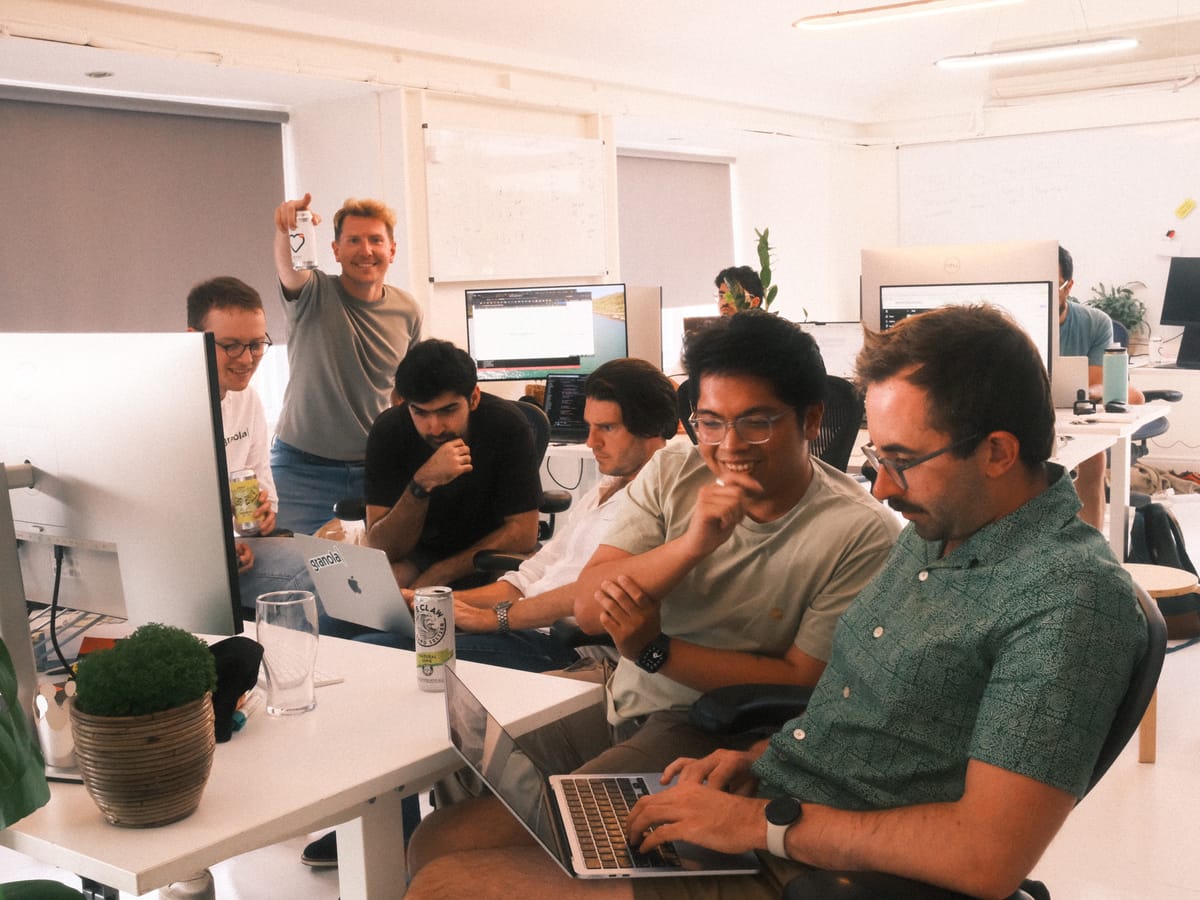
What if every meeting could make you a better leader? Here's how I made it happen with Granola.
Late last year, during a conversation with my CEO, he shared an ambitious vision for 2026: elevating leadership capabilities for managers at Pictarine. Over the past few years, our People department built an internal Academy for managers; internal and external trainings, weekly discussions and practice sessions. Now they are taking it further, focusing specifically on leadership development.
His reference point? Special forces training. These teams excel at maintaining clarity and making decisions under extreme pressure with limited information. They embody a particular kind of leadership: calm under fire, crystal clear in communication, and strategically focused even in chaos.
That conversation planted a seed. I'd always dreamed of having a pocket coach; someone who could observe every meeting, catch every nuance, and offer immediate feedback to help me improve by sharing precise and actionable insights. And by immediate, I mean getting help to take a step back rather than just reinforcing what's already obvious.

Then it stuck with me: what if I could use AI to analyse Granola meeting transcripts as my digital leadership coach?
Building my digital coach
I started with our first team meeting of 2026, focused on strategic priorities for the year. I recorded it with Granola, then fed the transcript to both ChatGPT and Claude for comparison purposes with identical prompts containing my leadership goal and team context.
The results from ChatGPT were stunning. It didn't just give generic feedback but it quoted specific moments from the transcript:
- A moment where my explanation lacked clarity and likely left the team confused.
- An instance where I should have asked for a deadline but didn't.
- A missed opportunity to explicitly recognise strong work from a team member.
- Moments where I effectively facilitated discussion and drove alignment.
The precision was remarkable. ChatGPT wasn't analysing me in abstract terms: it was showing me exactly where I succeeded and stumbled, using my own words as evidence!
Based on this analysis, I asked ChatGPT to help me build a structured self-assessment framework. The result was a monthly evaluation grid covering five key dimensions:
1. Clarity & direction
- Do I provide clear direction at the start of meetings?
- Do I prioritize without ambiguity?
- Do I connect vision to execution?
2. Decision-making & arbitration
- Do I explain my decisions clearly?
- Do I make my reasoning pedagogical (teaching the team why, not just what)?
- Am I a decision bottleneck, or do I enable team autonomy?
3. Communication & attitude
- Do I speak with clarity and structure?
- Do I get to the essential point?
- Is my tone calm and composed?
4. Team leadership
- Do I explicitly reinforce good contributions?
- Do I create psychological safety?
- Do I encourage autonomy?
5. Collective facilitation
- Do I provide regular synthesis during meetings?
- Do meetings end with clarity?
- Does the team leave aligned?
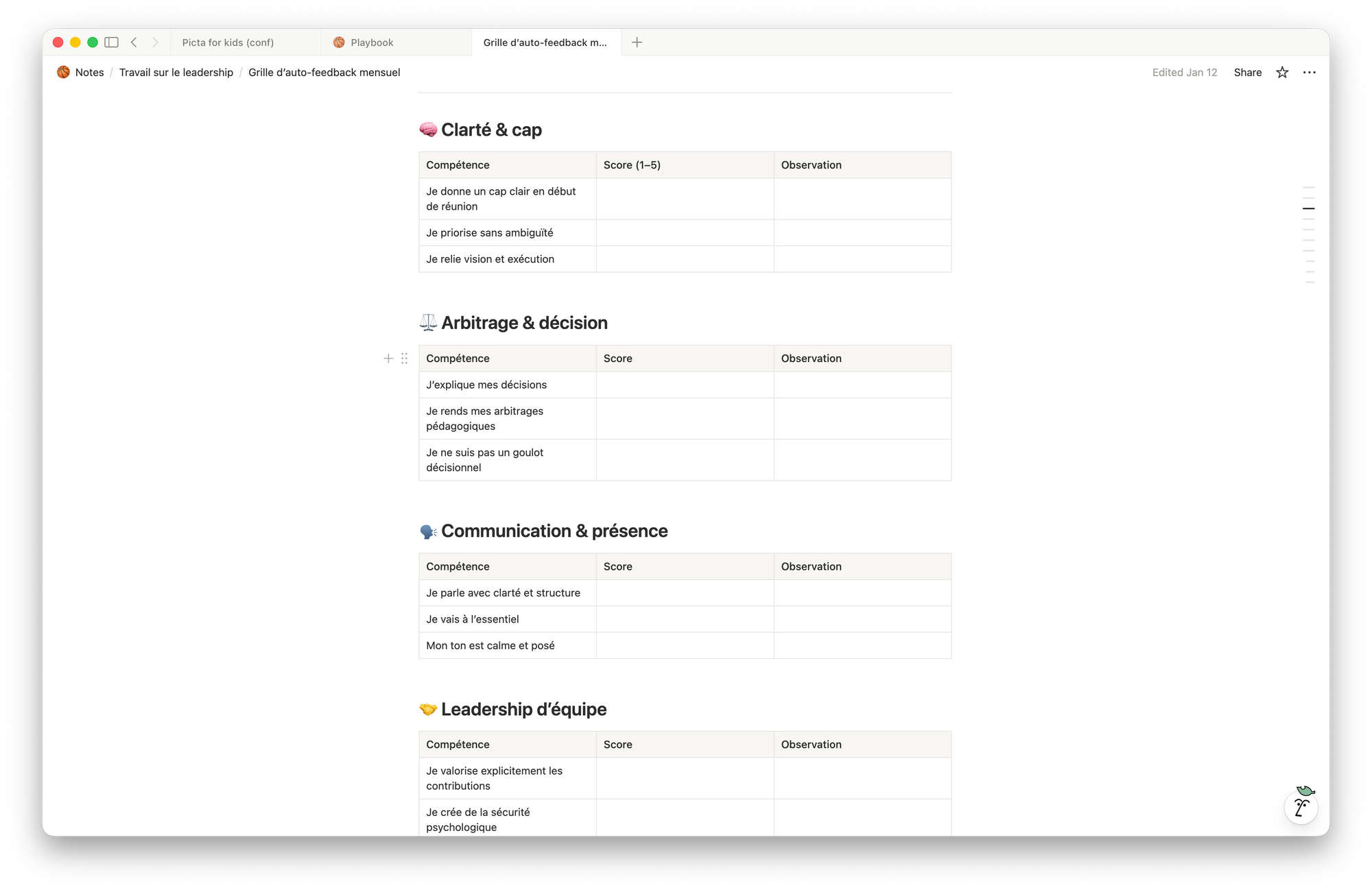
Each dimension uses a 1-5 scale, with space for observations and concrete examples. At the end of each monthly review, I identify:
- My current superpower.
- My main blind spot.
- One specific behaviour to test in the coming month.
The Granola recipe: my leadership autopilot
Rather than manually copy-pasting transcripts each time, I created a custom Recipe in Granola: essentially a reusable prompt that I can trigger instantly.
Here's how it works: When I'm viewing notes from one of my Growth Sync meeting or browsing this meeting folder, I simply type /leadership and my digital coach springs into action. It analyses the transcript against my framework and provides structured feedback.
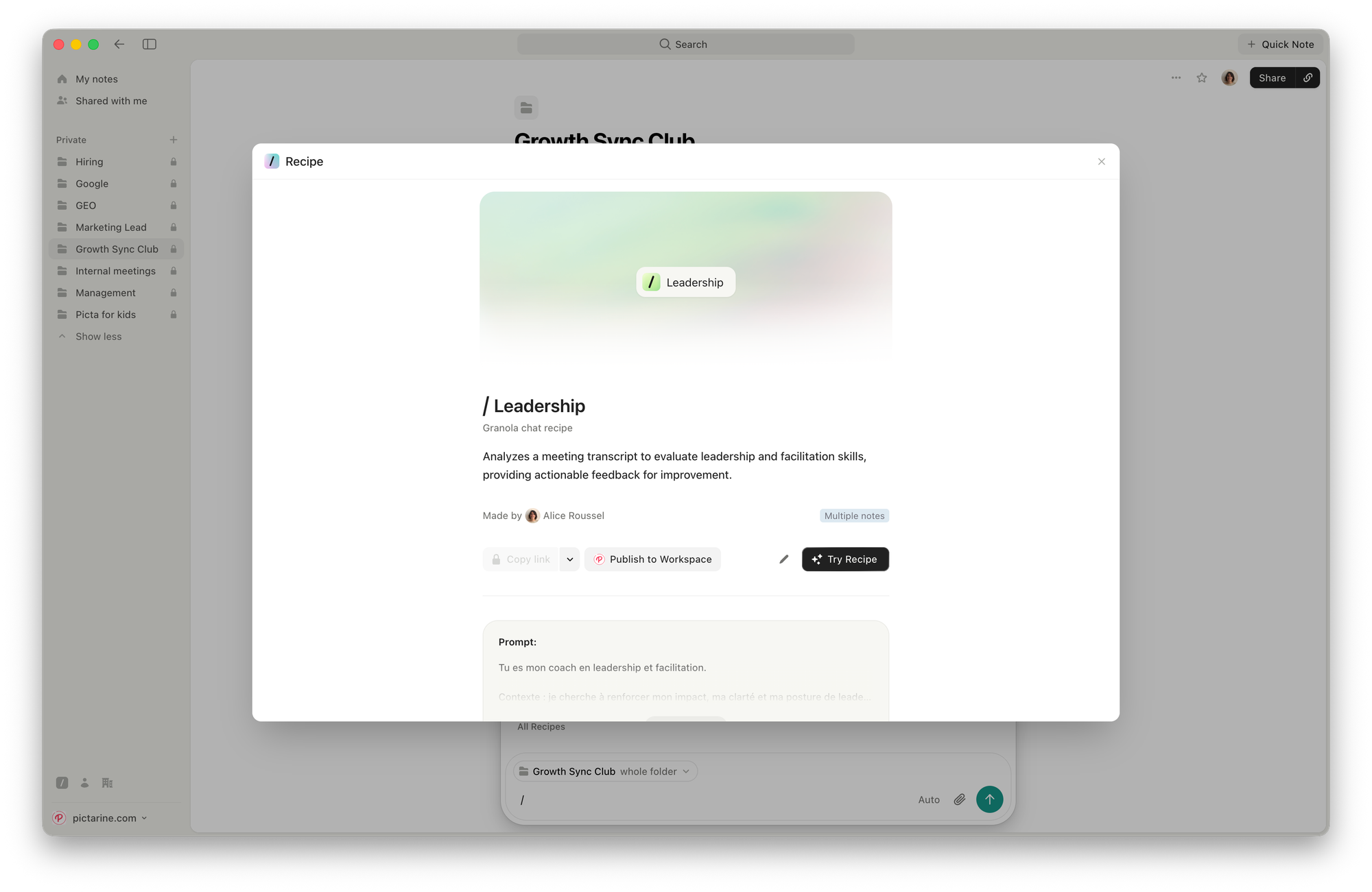
The recipe includes:
- My objective for improving my leadership style.
- Context about my team (who they are, what they do).
- Our 2026 strategic priorities.
- The five-dimension evaluation framework.
- My current focus areas for improvement.
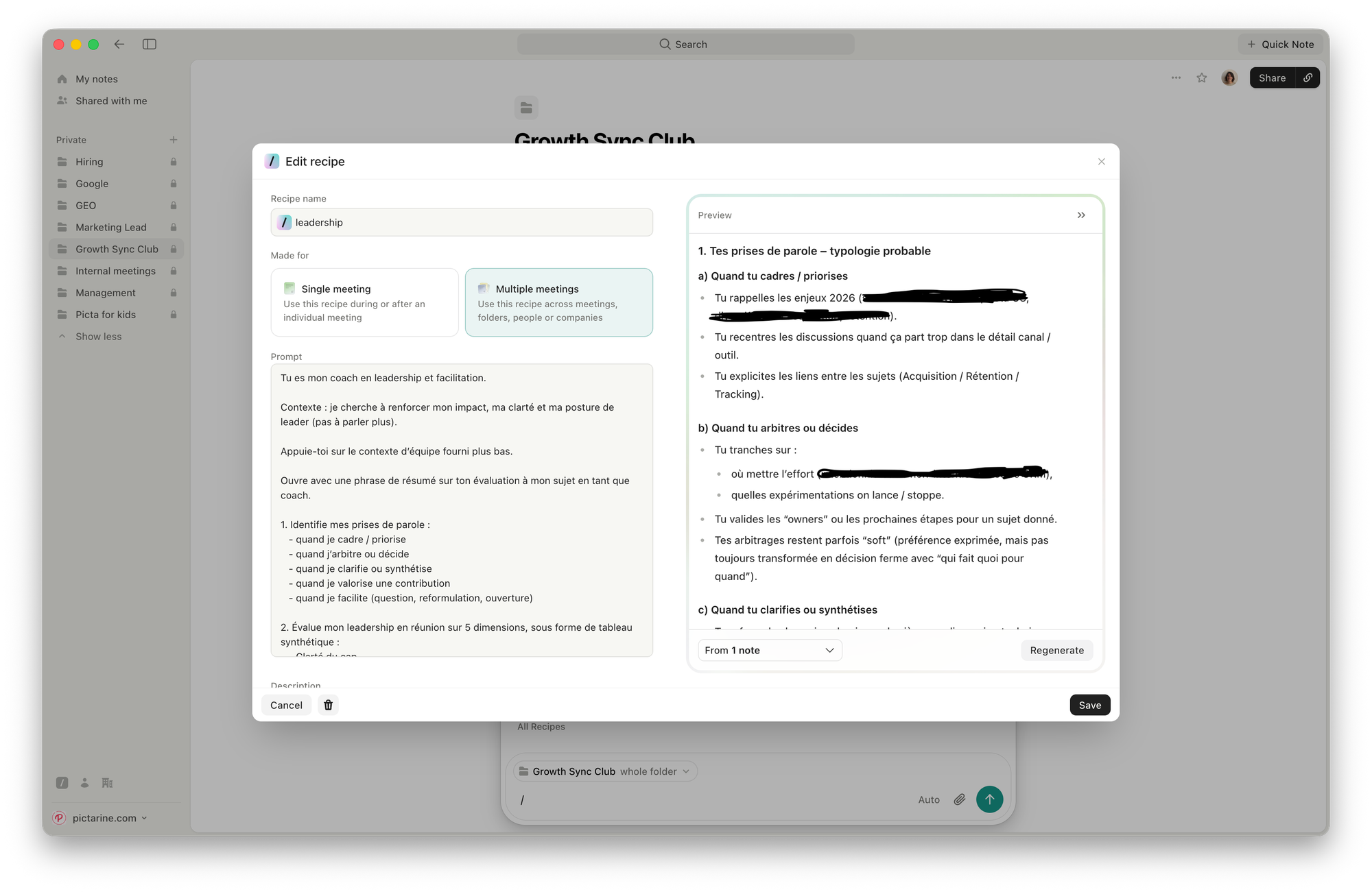
One caveat I discovered: don't explicitly tell the recipe to refer to the transcript, it does this automatically. When I added that instruction, it ironically claimed it didn't have access to transcripts. A quirky bug, but easy to work around.
What I'm learning and changing
It's still early, but the feedback has already shifted my behavior in one concrete way: I'm being more explicit.
I used to make word economies: skipping explanations that seemed obvious to me. The AI called this out repeatedly. What felt clear in my head wasn't always clear to my team. Now I'm more deliberate about:
- Stating the reasoning behind decisions, even when it feels obvious.
- Explicitly naming priorities instead of assuming everyone inferred them.
- Verbalising validation when someone makes a strong contribution.
It sounds simple, but it's remarkably hard to catch yourself doing in the moment. That's where the transcript analysis becomes invaluable; it shows you patterns you can't see while you're in the meeting.
The AI also catches:
- When I over-explain instead of synthesising.
- When I fail to close a topic with clear next steps.
- When my pedagogical arbitration is actually present.
Because I've embedded my improvement areas directly in the recipe prompt, I can track progress meeting by meeting. As my transcript library grows, I'll be able to see trends over weeks and months.
Expanding the practice
Currently, I'm primarily recording Growth Sync meetings: our main team meeting. But I'm considering expanding to:
- 1:1s with my team: to improve my coaching effectiveness and ensure alignment.
- Monthly coaching sessions: where I track progress on each team member's semester objectives.
- Cross-functional marketing leadership meetings.
Making this work for you
If you want to build your own digital leadership coach, here's what I'd recommend:
1. Start with a clear, simple objective: don't just say: improve leadership. Be specific: "Help my team think better, decide faster, and leave meetings aligned." Mine is literally: "Does my contribution help the group think better, decide faster, and leave aligned?"
2. Provide rich context: include who's on your team, their expertise, and your strategic priorities for the year. The more context the AI has, the more relevant its feedback will be.
3. Build your framework first: use your first transcript analysis to co-create an evaluation grid with the AI. Make it personal based on your actual leadership challenges, not generic management theory.
4. Create a recipe (or equivalent saved prompt): save your prompt structure so you can reuse it effortlessly. The friction of copy-pasting kills consistency, really.
5. Review monthly, not daily: don't obsess over every meeting. Look for patterns across multiple sessions to identify real trends versus one-off moments.
Beyond personal development: recipes as collective tools
While my leadership recipe is deeply personal (tailored to my specific challenges and team context), the real power of Granola recipes extends far beyond individual use.
Recipes can be shared: with your team, with other managers and even across the entire company.
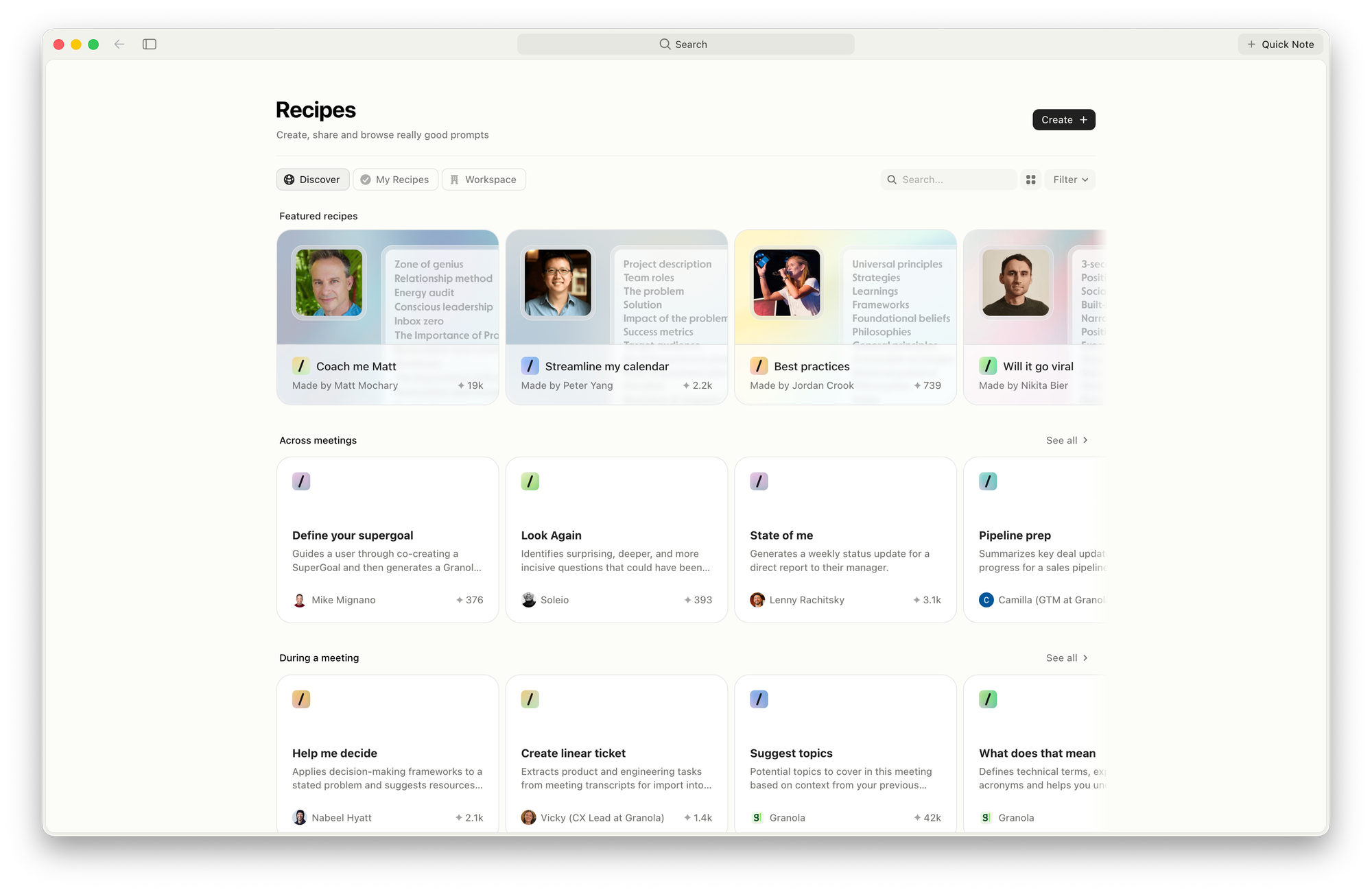
For more general, less personal contexts, recipes become incredibly useful collective tools. Imagine:
- A Squad alignment recipe for our squad synchronisation meetings. These sessions are critical because the Product Manager shares progress, and there's often intense challenge and debate. Good ideas emerge, but they can also derail focus. A recipe could help keep strategic priorities front and center, flagging when discussions drift from core company objectives, even when the ideas themselves are compelling.
- A Manager knowledge base recipe for our manager meetings where we share wins and struggles. Rather than letting these insights evaporate, a recipe could help structure and archive them, building a living database of management practices at Pictarine. For example, documenting how we used Working Geniuses in a recruitment process, or how a manager navigated a difficult performance conversation. Over time, this becomes organizational memory that new managers can learn from.
The beauty is that once someone creates a high-quality recipe for a common use case, everyone benefits. You're building organizational intelligence that compounds over time.
At Pictarine, I can imagine our leadership team sharing recipes that reflect our company values and communication standards, creating a shared language for what great meetings look like.
Try it yourself
If you're curious about building your own leadership feedback loop, I highly recommend trying Granola. The ability to record meetings, generate clean transcripts, and create custom recipes has made this entire practice effortless.
 Nat Friedman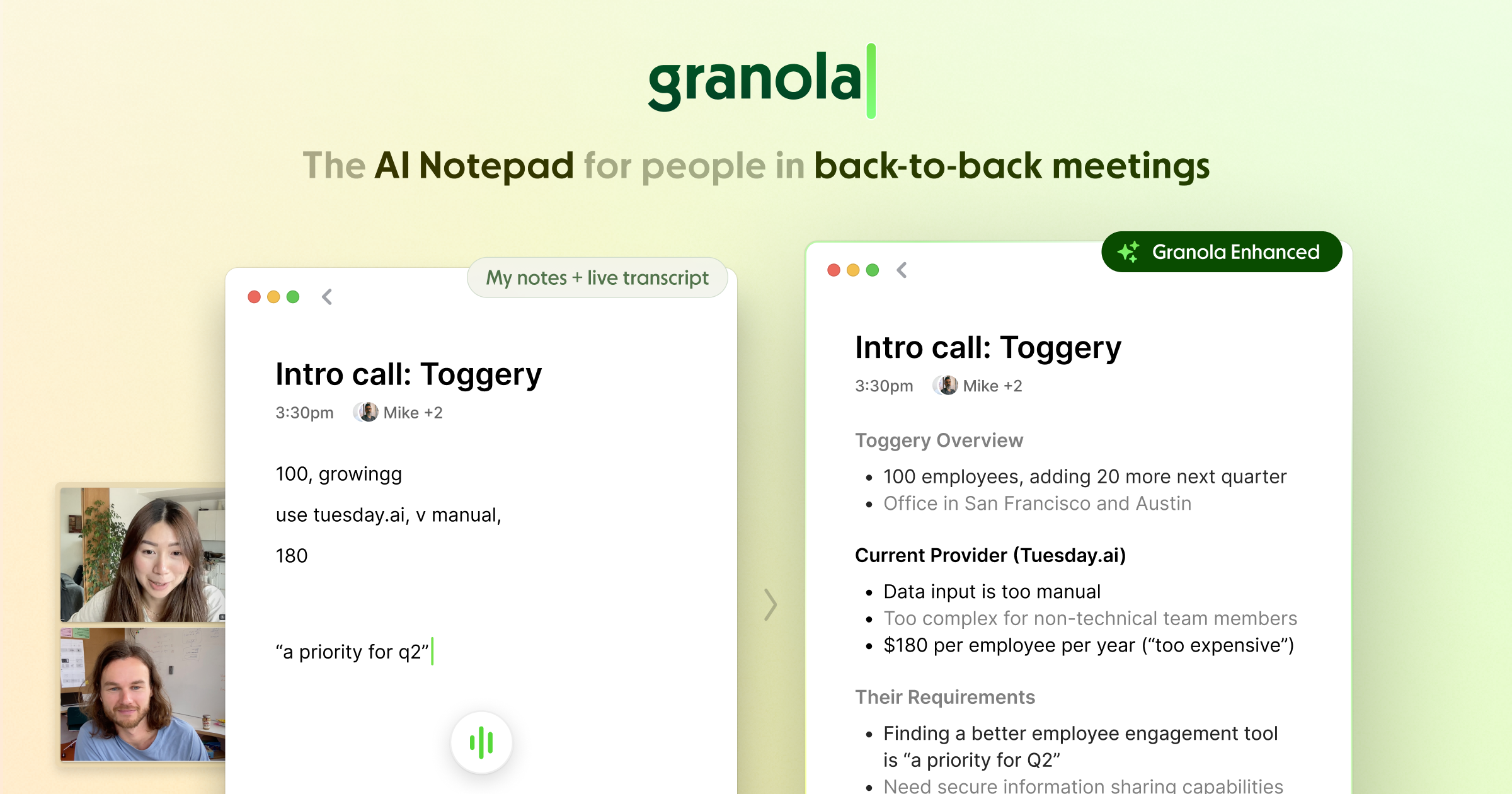
This is an affiliate link (just testing it out, you know).
The setup takes ~20 minutes: from downloading Granola to creating and testing your recipe. The insights are immediate. And unlike traditional coaching, your digital coach is available for every single meeting, ready to help you get better, one conversation at a time 🙂
Comments ()